
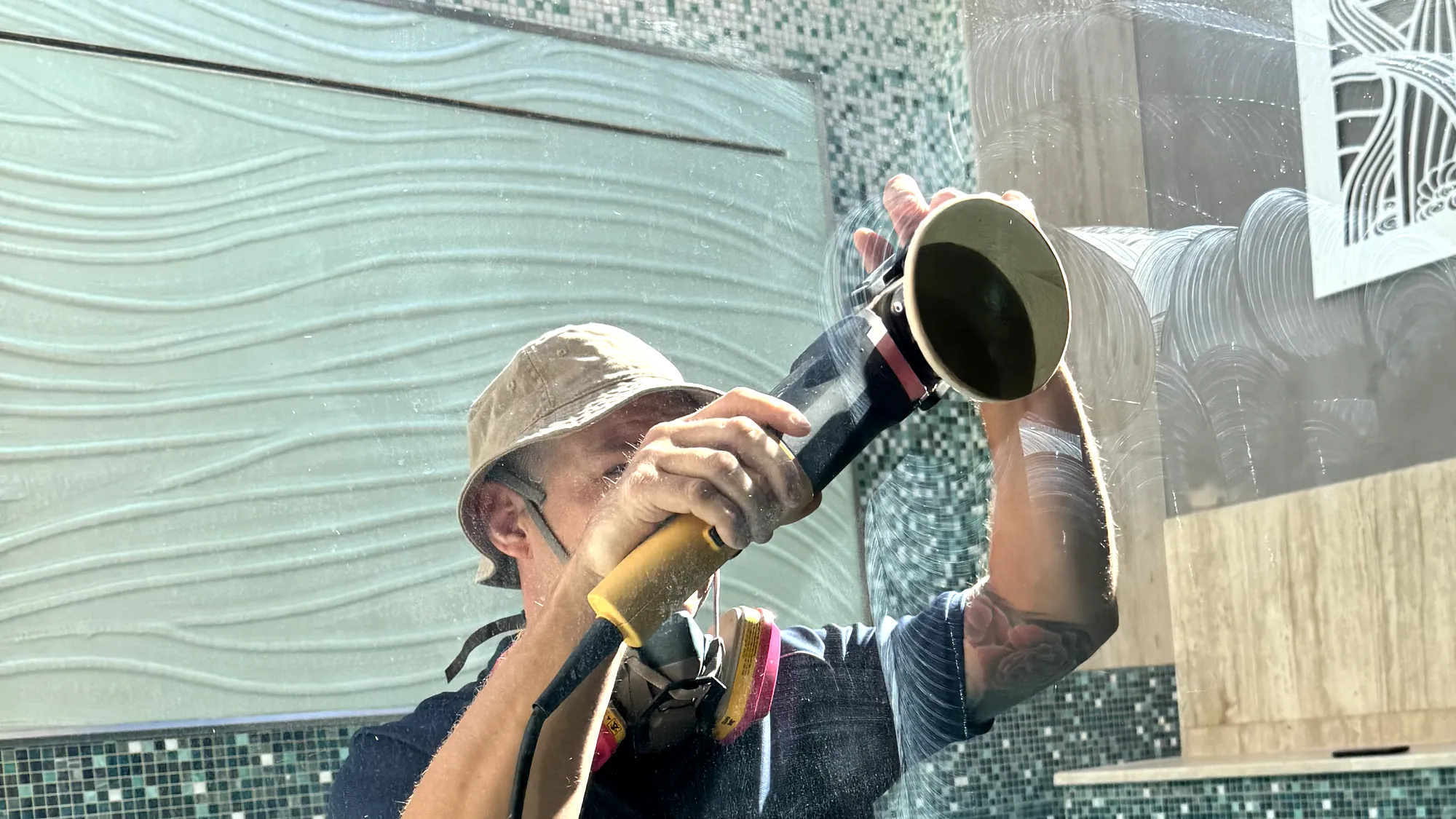
Glass restoration · Perth & WA
The glass everyone told you to replace.
Bore staining baked on over summers. Hard-water etching, corrosion and pitting a window cleaner has already given up on. Scratches somebody swore meant a new pane. This is specialist glass restoration in Perth: we take that damage out of the glass mechanically and polish the surface back to clear, for a fraction of what reglazing costs. If it isn't cracked or broken, it can almost certainly be saved.
Who you're talking to
Western Australia's only dedicated glass restoration specialists.
Not a sideline to a window-cleaning round. Not something a glazier has a go at between jobs. Restoration is its own trade and it does not overlap with anyone else's.
Its own abrasives, cut for glass and stepped through grades most trades have never had in their hands. Its own machines, and a method chosen to suit the glass and the damage in front of us, because the wrong approach on the wrong pane is what warps it. And its own way of reading damage: working the glass in raking light to tell you, before anything is touched, how deep it actually goes and what it will take to get out. Get that read wrong and you dish the pane and turn a repair into a replacement.
Almost nobody in this state does this. We do it full time, and we have years of experience behind us.
It's the whole business
Restoration and scratch removal aren't a service line we bolt on when a clean fails. They're what we do. Everything else we offer exists because it sits either side of this.
"It can't be fixed" usually means "I can't fix it"
Most people are told the pane is a write-off by someone with no way of saving it. A cleaner, a glazier and a restorer will give you three different answers, and only one of them is holding the right kit.
Not just windows
Facades, balustrades, pool fencing, shopfronts and commercial glazing, plus the things that don't fit a category: splashbacks, mirrors, glazed partitions, display and cabinet glass. If it's glass and it isn't a shower screen, ask.
Years of WA glass
Bore reticulation, high-silica scheme water, coastal salt and relentless sun. WA corrodes glass in specific ways, and we've seen enough of it to tell you what will happen before we start.
The straight answer
There are only two outcomes.
People expect a long list of conditions. There isn't one. Damage to the surface of the glass comes out. Damage to the structure of the glass doesn't.
Anything in the surface
Bore and reticulation staining. Baked-on hard-water scale. Mineral etching, corrosion and pitting. Iron staining. Scratches, scrapes and scuffing. Render, paint, grinder and weld spatter. Salt haze, clouding, bloom and general weathering. All of it sits in or on the face of the glass, and all of it can be taken out and the surface polished back to clarity.
Cracked or broken
A crack, a shatter, an impact break or a laminate that has delaminated is structural. There is no restoring that, and anyone who says otherwise is selling you something. This is genuinely the only category we turn away, and we will tell you on the spot rather than take the job.
The work
What restoration actually looks like.
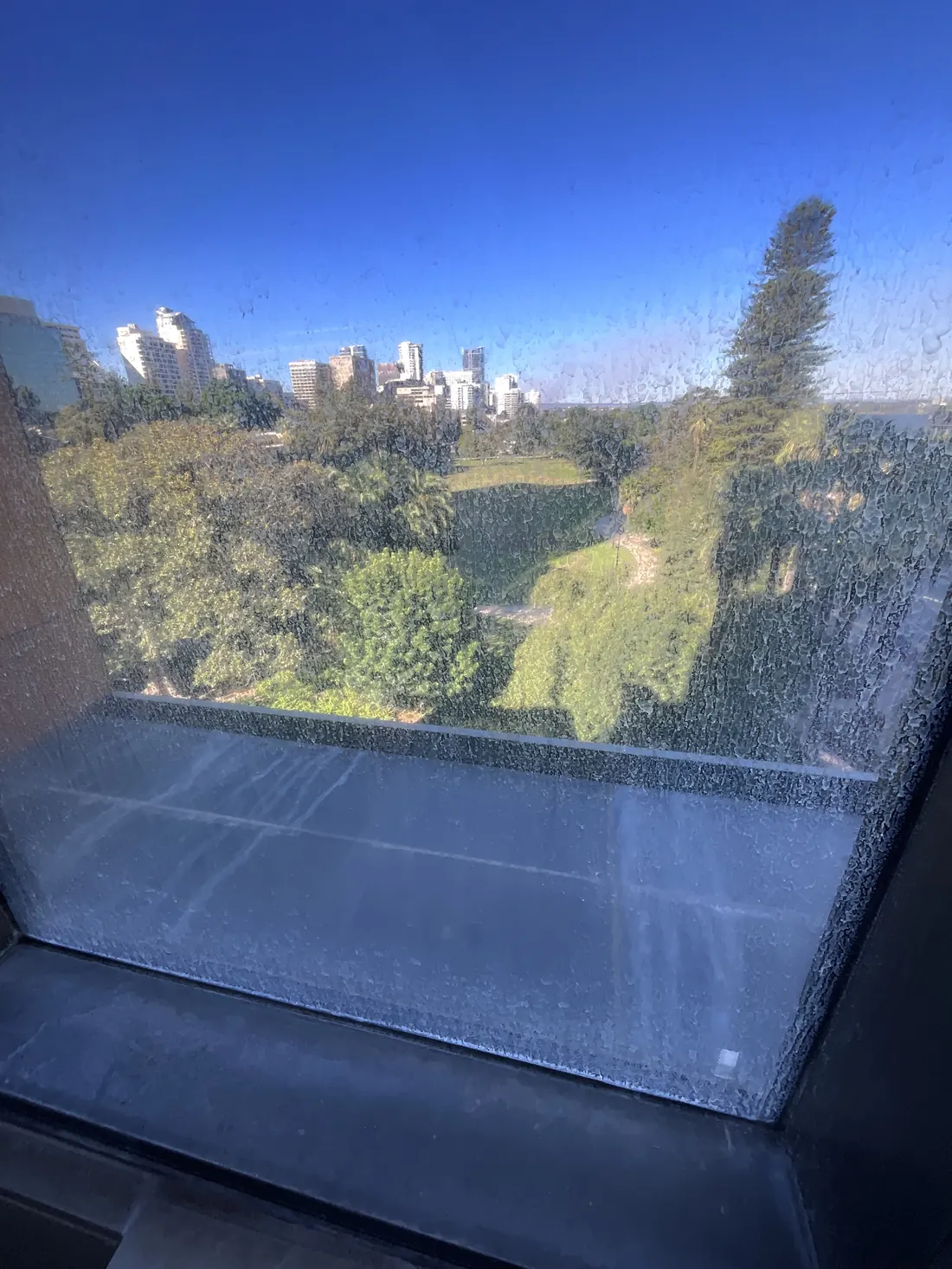
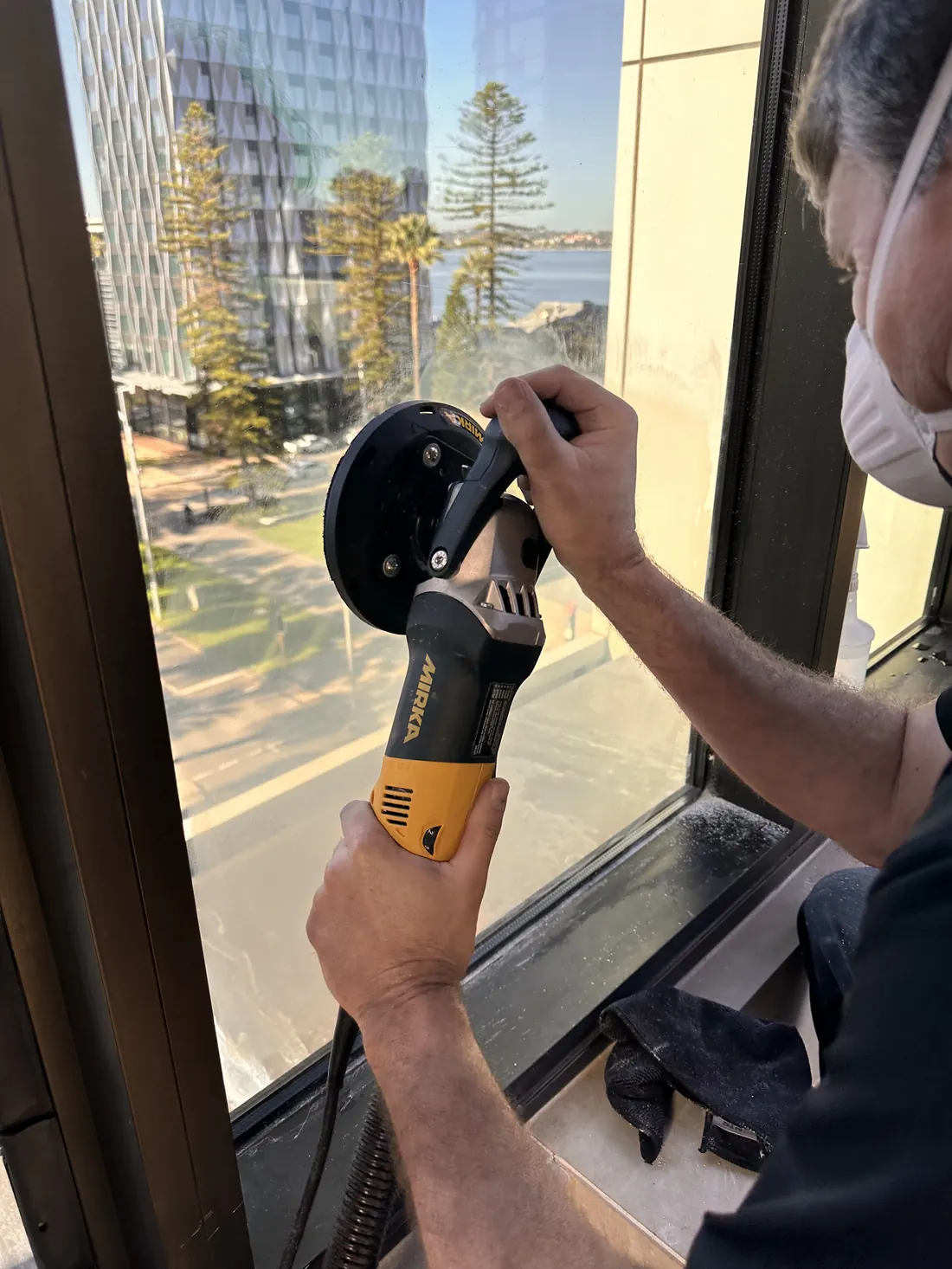
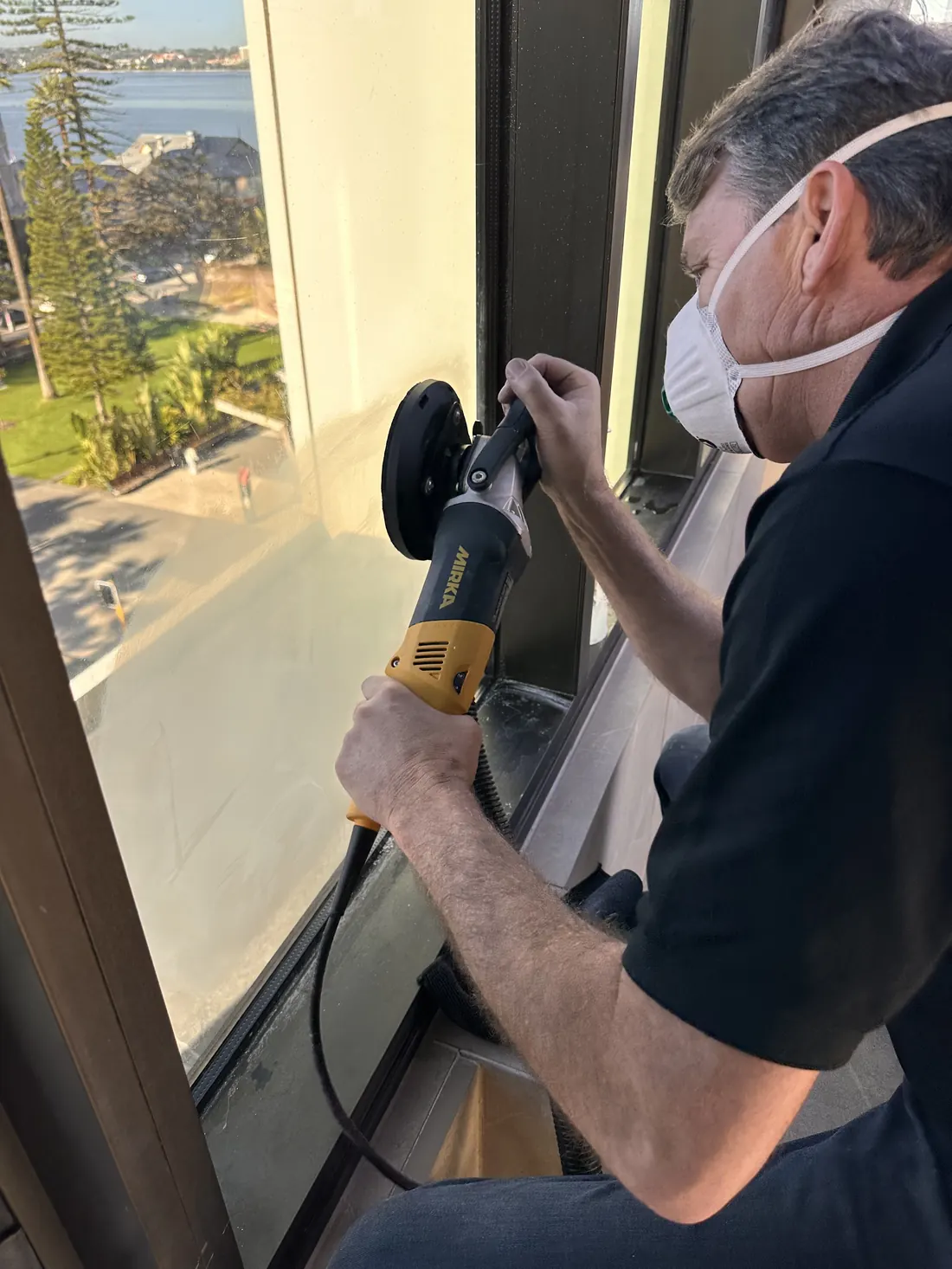
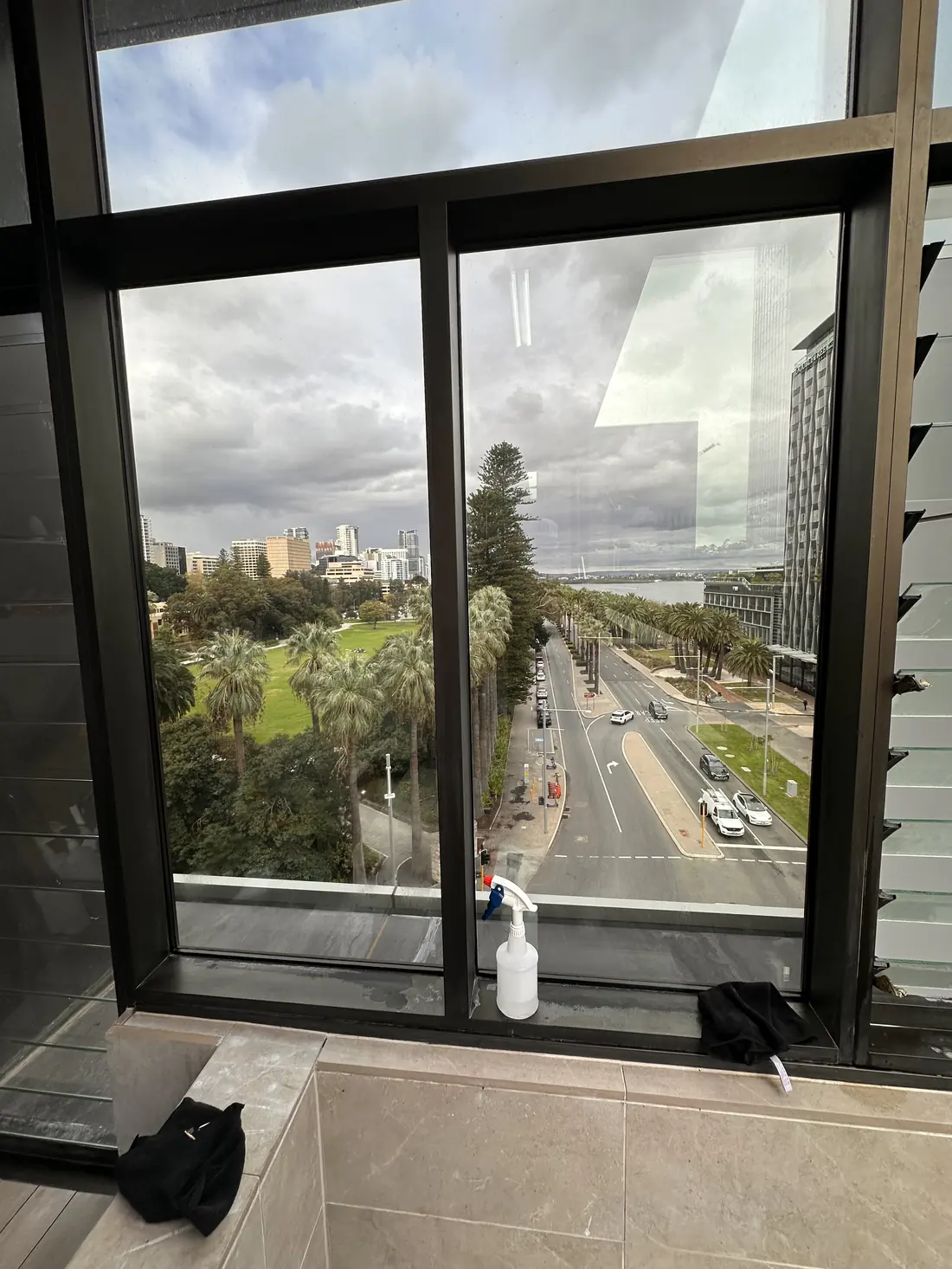
Glass damage is genuinely hard to photograph. A camera flattens what your eye picks up instantly at a raking angle, so a before-and-after of a stained pane rarely shows you anything real. Here is the work itself instead.
Why cleaning can't fix it
Everyone blames the calcium. It's the silica.
Perth water leaves two minerals on your glass, not one. Calcium carbonate is the famous one, the chalky scale in a kettle, and it is the one every cleaning product on the shelf is built to attack. The other is silica, almost nobody has heard of it, and it is the one that actually ruins the glass.
This is the whole reason restoration exists as a trade, and the reason people burn months on products that were never going to work.
Two minerals land, not one
Reticulation or hard scheme water hits the glass and evaporates in the sun. Calcium carbonate crystallises out, and so does dissolved silica. Perth's groundwater-fed north and inner-north run both hard and unusually silica-rich, and reticulation sprays that water onto glass every morning through the hottest months of the year. Caught while it's still fresh, the whole lot still wipes off. That is the only stage where cleaning wins.
The calcium sets. The silica welds.
The calcite behaves like limescale: it crystallises, it's brittle, and it stays chemically separate from the pane. The silica does something else entirely. As the water dries, dissolved silicate units polymerise, linking to each other into a continuous, glassy, insoluble film, and cross-linking into the surface of the glass underneath. Chemically it is the same family as the pane it is sitting on. It stops being a deposit on your window and becomes a thin layer of new glass welded to your window.
Why vinegar half-works, then stops dead
This is where people lose months. Acid attacks carbonate, so vinegar, lemon juice and CLR genuinely dissolve the calcium half, and for a little while the glass looks like it's coming good. Then it stops, because acid does essentially nothing to a polymerised silicate film. You have stripped the soft half and left the hard half bonded to the pane, and every wet-and-dry cycle since has laid down another layer of it. Scrubbing harder from here just adds scratches. There is no household chemistry that takes silica off glass without taking the glass with it.
Then it stops being a deposit and becomes corrosion
Trapped under that mineral film, water can no longer evaporate freely and the thin layer against the glass turns alkaline. Past roughly pH 9, hydroxide attacks the glass network directly: first leaching ions out of the surface, then breaking the silicon-oxygen bonds that hold the structure together. That is glass corrosion, and it shows as etching, pitting, clouding and permanent haze. Material has physically gone. There is nothing left to dissolve, because the damage is not on the glass any more, it is the glass.
Which leaves exactly one option
A welded silicate film and a corroded surface both come off the same way, and it isn't chemistry. We abrade to the depth of the damage, step down through progressively finer abrasives to refine and blend the worked area into the surrounding pane, and finish with a cerium-oxide polish that brings the optical clarity back. Skilled, slow, and the reason it's quoted on assessment.
How the job runs
Assessed first, always.
Restoration is not a service anyone should quote off a photo and a hope. The time it takes depends entirely on how deep the damage has gone, how many panes there are and how hard they are to get to, which is exactly why there is no price list on this page.
We look at the glass, work out what stage it is at, and tell you what it needs. If it is a replacement, you'll hear that first, and you won't pay us to find out.
- We assess the actual glass. Deposit, etch, scratch, or a mix. Depth matters more than area, and it is not something you can read off a photo.
- We test a section first. On a large or unusual job we restore a test area so you can see the result on your own glass before committing to the rest.
- You get told the truth about the pane. Including when the answer is that it should be replaced, or that a screen isn't worth restoring.
- Then it's quoted per job. One figure, based on the glass in front of us, not a per-metre rate that ignores how bad it is.
- Residential, commercial and construction. Homes, apartment and strata glazing, balustrade runs, pool fencing, shopfronts, commercial facades and builders' defect work.
- Perth and the South West. Metro as standard, South West by arrangement.
For builders, strata & facility managers
The glass is the small number.
On a building, replacing a stained or damaged pane is never just the pane. It is the unit on lead time, the glazier, the access equipment, the permits, the trade coordination and the disruption to everyone using the building while it happens. Restoration removes almost all of that, because the glass never leaves the opening.
The higher and harder the glazing is to reach, the further the two numbers pull apart. On a facade at height, access is most of the cost of doing anything at all, so doing it once and doing it in situ is the entire argument.
One trade, one visit
We work the glass where it sits. No unit to order or wait on, no glazier, no crane or scaffold booked to pull and reset glazing, no reveal made good twice, and no tenants, residents or trading floor working around an opening. On a defect list before handover it is also the option that doesn't move the programme.
Everything else moves with it
Order the unit, wait out toughening or lamination, re-book access and craneage, pull the old glazing, make good, reset and reseal. Every one of those is a cost and a date, and on toughened, laminated, oversized or double-glazed units the wait alone can run weeks. It is the right answer for cracked glass. It is an expensive answer for stained glass.
Don't do this twice
Restored, then protected.
Restoration fixes the glass you have. It doesn't change the water still landing on it. If the reticulation keeps hitting the same pane, you are on the same road again.
So we usually finish a restoration with GlassProtect on the clean surface. Water beads up and sheets straight off instead of sitting there, so rain and a quick rinse do most of the work and the glass largely keeps itself clean. It protects glass against permanent etching, it is tested 3× more durable than the leading brand, and it comes with a registered JUMBOGUARD guarantee. Bluntly: it is the cheapest part of the whole exercise and the part that decides whether you are back here in three years.
Also on glass
The rest of what we do.
Questions, answered
Straight about what can be saved.
My windows are stained from bore water. Can they actually be saved?
Almost always, yes. Bore and reticulation water leave a mineral deposit that cements onto the glass, and left in the sun long enough the minerals etch into the surface itself. Cleaners cannot touch either one. Restoration is mechanical: we abrade the damage out of the glass and polish the surface back to optical clarity. If the pane is intact, staining and etching are very rarely the thing that writes it off.
When is glass actually too far gone to restore?
When it is cracked or broken. That is the honest line. Staining, mineral etching, corrosion, pitting, scratching and scuffing are all surface damage, and surface damage can be taken out. Structural damage cannot, so a cracked, shattered or delaminated pane is a replacement, not a restoration. We tell you which one you have before you spend anything.
Is this just a really good clean?
No. Cleaning removes what is sitting on the glass. Restoration removes damage that is in the glass. Once a mineral deposit has cemented and the silica has set, no cleaner or acid will shift it, and once the glass is etched there is nothing left to dissolve because material has physically gone. Restoration works mechanically, with progressively finer abrasives and a cerium-oxide polish, so it is a different trade to window cleaning.
I've tried vinegar and CLR. Why didn't they work?
Because they only ever address half of what is on the glass. Perth water leaves calcium carbonate and silica together. Acid dissolves the carbonate, which is exactly why the glass improves for a while and then stops dead. The silica has polymerised into a glassy, insoluble film cross-linked into the surface of the pane, and acid does essentially nothing to it, so you end up having stripped the soft half and left the hard half welded on. Scrubbing harder from there only adds scratches. Taking silica off glass is a mechanical job, not a chemical one.
Do you restore shower screens?
No, and that is the one exclusion. Everything else made of glass is worth asking about: windows, facades, balustrades, pool fencing, shopfronts, commercial glazing, splashbacks, mirrors, glazed partitions and display glass. On a shower screen the panel is usually cheap enough that replacement is the smarter money, so we will tell you that rather than sell you a restoration you do not need.
What does glass restoration cost?
It is quoted on assessment, never off a price list. The work is specialist and the time it takes depends entirely on how deep the damage has gone, how many panes there are and how hard they are to reach. We look at the glass, tell you what it needs, and quote the job.
Will it stain again after you restore it?
If nothing changes, the same water keeps landing on the same glass. That is why we usually pair restoration with two things: sorting out where the reticulation is actually spraying, and coating the restored glass with GlassProtect so water beads and sheets off instead of sitting there, and the glass largely keeps itself clean. GlassProtect also protects glass against permanent etching.
Is glass restoration covered by a guarantee?
Restoration is the fix, not a subscription. Once we take bore staining, etching or scratching out of the glass, that damage is gone, it does not creep back. The registered guarantee is a separate instrument and it belongs to the coating, not the restoration. When we finish a restoration with GlassProtect on the clean surface, that coating is applied to a JUMBOGUARD standard and registered under a JUMBOGUARD guarantee: 5 years on existing glass, 10 years on new. So restoration clears the glass, and the coating guarantee is what keeps it that way. We will never tell you the restoration itself is guaranteed for a decade, because that is not how the work, or the instrument, actually works.
Get it assessed
Before you pay to reglaze it.
Send your suburb and a photo of the worst pane. We'll tell you whether it's a restoration or a replacement, and quote the job on what's actually in front of us.